


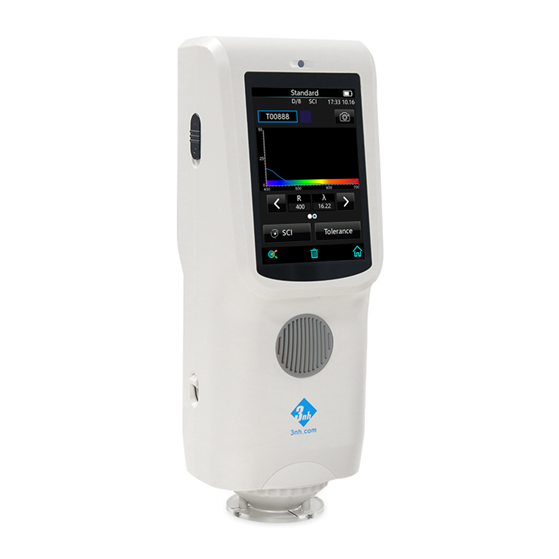
In the relentless pace of modern manufacturing, efficiency is currency. On the production line, in the warehouse, or at a supplier’s facility, the need for rapid, reliable, and unambiguous color decisions is paramount. While high-end spectrophotometers offer deep spectral analysis, many daily tasks simply require a fast, definitive answer: “Is this color correct?” The TS7036 Spectrocolorimeter is engineered specifically for this purpose. It’s a tool that prioritizes speed, ruggedness, and operational simplicity, making it the ideal companion for high-volume inspection and field verification.
But does focusing on speed mean compromising on accuracy? This review puts the TS7036 through its paces to see if it delivers the reliable performance needed for demanding industrial environments.
First Impressions: A Tool Built for the Real World
The TS7036 makes a strong first impression with its no-nonsense, utilitarian design. It’s built with a high-impact-resistant housing that feels like it can withstand the drops, bumps, and dust common in factory and field use. The ergonomics are a standout feature; the grip is comfortable and secure, allowing for stable, one-handed operation—a critical factor for repeatability when you’re measuring dozens of samples in a row.
The interface is refreshingly straightforward. A clear, bright display (often an easy-to-read LCD) shows all essential information at a glance: the color values and a clear pass/fail indicator. The button layout is minimal and intuitive, requiring minimal training for a new operator to get up and running. This device feels less like a complex scientific instrument and more like a specialized, high-tech gauge—and that is precisely its strength.
Key Features: The Engine of Efficient Color Control
The TS7036’s feature set is meticulously curated to excel in fast-paced, pass/fail environments.
- High-Speed Tri-Stimulus Measurement: As a spectrocolorimeter, the TS7036 is optimized for speed. It uses filtered optics to provide highly accurate tri-stimulus color measurements (CIE L, a, b*, and others) in a fraction of a second. This is its core advantage. The rapid measurement cycle allows an operator to check a high volume of parts, textiles, or materials per hour, making it perfect for 100% inspection protocols or rapid batch sampling.
- Durable, Production-Ready Design: The TS7036 is built for life on the move. It often carries an IP rating (e.g., IP52 or higher), signifying protection against dust and water splashes. This ruggedness ensures that a spill or a fall from a workbench isn’t a catastrophe, providing peace of mind and reducing downtime.
- Simple, Instant Pass/Fail Assessment: The workflow is brilliantly simple. A master standard is set. Subsequent sample measurements instantly display the Delta E (ΔE) color difference and, most importantly, a clear visual indicator—like a green checkmark or a red “X”—showing whether the sample is within tolerance. This binary feedback eliminates interpretation errors and empowers operators to make confident, immediate decisions.
- Stable and Repeatable Performance: While it may not have the ultra-tight specs of a research-grade benchtop, the TS7036 offers more than sufficient accuracy and excellent repeatability for industrial QC. With a typical repeatability of ≤ 0.08 ΔE*ab, it provides consistent data. This means that if a sample is on the edge of the tolerance limit, the instrument will give the same result repeatedly, ensuring fairness and consistency in the inspection process.
- Excellent Battery Life and Connectivity: The device is designed for all-shift operation, featuring a long-lasting lithium battery that won’t quit during a critical audit. For data logging, it includes essential connectivity like USB and often Bluetooth, allowing measurements to be streamed to a computer or a simple database for traceability.
The User Experience: Mastering the Device in Minutes
The true value of the TS7036 is its almost non-existent learning curve.
- On-Board Operation: There is no complex software to master on the device itself. The menu is typically a few layers deep at most, allowing users to set tolerances, switch between color spaces, and view measurement history with ease. The focus is on getting a reading, not on navigating menus.
- Complementary PC Software (Optional): For those who need it, basic PC software is available for data management. This allows for downloading measurement history, creating simple reports, and managing a library of standards. However, the TS7036 is designed to be fully functional and effective without ever being connected to a computer.
Real-World Performance: The TS7036 on the Front Lines
We evaluated the TS7036 in scenarios where its speed and simplicity are paramount.
- Injection Molding Production Line: Here, the TS7036 shone. An operator could quickly pick up a newly molded part, press the measure button, and get an instant pass/fail result. The speed allowed for every tenth part to be checked without creating a bottleneck, catching color drift from the molding machine early.
- Textile and Apparel Final Inspection: Before packaging, finished garments were spot-checked for color consistency. The simple pass/fail result allowed inspectors with no color science background to reliably segregate any off-shade products, protecting the brand’s reputation for quality.
- Supplier Quality Audit: An auditor brought the TS7036 to a component supplier. The rugged design survived the journey in a toolbag, and the long battery life allowed for a full day of spot-checking incoming materials against a physical standard stored in the device. The instant results facilitated immediate, data-driven conversations with the supplier.
- Limitation for Complex Analysis: It’s crucial to understand that the TS7036 is not designed for color formulation or analyzingmetamerism. Its strength is in verifying conformance to a known standard, not in diagnosing why a color is off.
Ideal Applications and Users
The TS7036 is the perfect solution for:
- Production Line Operators: For high-speed, repetitive quality checks.
- Warehouse and Incoming Inspection Teams: For verifying the color of raw materials and components.
- Field Service and Audit Technicians: Who need a rugged, portable, and easy-to-use tool for supplier visits.
- Small Workshops and Fab Shops: (e.g., paint touch-up, custom fabrication) that need an affordable, professional tool for color matching.
- Industries with High-Volume Output: Plastics, textiles, packaging, and building materials.
Pros and Cons: The Honest Breakdown
Pros:
- Exceptional Speed and Efficiency: Dramatically increases inspection throughput.
- Extremely User-Friendly: Minimal training required; ideal for high-turnover operator roles.
- Rugged and Reliable: Built to survive demanding industrial environments.
- Clear, Unambiguous Results: The pass/fail system prevents interpretation errors.
- Excellent Value: Provides professional-grade color inspection at an accessible price point.
Cons:
- Not for Spectral Analysis: Cannot provide spectral curves or data for color formulation.
- Limited Diagnostic Capabilities: Excellent for finding a problem, not for solving the root cause of complex color issues.
- Single Aperture: Typically comes with a fixed aperture, which may not be suitable for very small or highly textured samples.
Final Verdict
The TS7036 Portable Spectrocolorimeter is a masterclass in focused engineering. It does not try to be everything to everyone. Instead, it excels brilliantly at its primary mission: providing fast, reliable, and simple pass/fail color inspection in real-world conditions.
For companies drowning in slow, subjective visual checks or for those who need to empower their frontline staff with objective data, the TS7036 is a transformative tool. It reduces human error, accelerates workflow, and provides a clear, defensible standard for color quality. If your goal is to make rapid, confident color decisions on the spot, the TS7036 isn’t just a good choice—it’s the most pragmatic and effective tool for the job.
